Thursday, April 7, 2016

Comparative Review: The New and Vintage Omega Speedmaster Mark II

Written by Robert-Jan Broer

Every Tuesday on my blog, www.fratellowatches.com, we tackle a topic related to Omega Speedmaster watches. This article comes to us from that “Speedy Tuesday” series, and focuses on my recent opportunity to review, compare and contrast the new Omega Speedmaster Mark II with its vintage predecessor from 1969.

After the Omega Speedmaster Professional won the race to the Moon in 1969, Omega thought it was time to come up with a watch that was perhaps a bit more up-to-date and ready for the 1970s — design-wise, that is, as the watch would still need to handle the same abuse as the Speedmaster Professional “Moonwatch” could. Sometime in 1969, Omega introduced the first Speedmaster Mark II, which was actually a Speedmaster Professional Mark II. (For non-native-English-speaking readers: the “Mark” in the name stands for a new or revised/improved version; it is similar to calling something a “2.0 version” these days.) The Speedmaster Mark II came with the same Lemania-based movement as the Moonwatch, Reference 145.022. This movement is Omega’s Caliber 861 and was in production from 1968 through about 1996, when it was succeeded by the Caliber 1861 movement. The Speedmaster Mark II had a barrel-shaped case that looked totally different from the asymmetrical Speedmaster Professional case. The regular Speedmaster, which was issued to NASA astronauts, was still in production, however. Throughout all the Speedmaster Mark series, the regular Speedmaster Pro remained available (and, of course, remains so today).
Omega Speedmaster Mark II Racing
When Omega ceased production of the Speedmaster Mark II in 1972, the Mark III already had been introduced. The Speedmaster Mark III was succeeded by the Mark IV in 1973. Then there is the Mark 4.5 (which is a Mark IV with a different movement, an Omega Caliber 1045), which came on the market in 1974. The last one of the Speedmaster Mark series is the Mark V, introduced around 1984. Confusing, right? There are even more models in between and some slight variations on the above. In any case, Omega decided to do a Speedmaster Mark II reissue in 2014, and we noticed that the watches were already in the Omega boutiques before their official introduction at Baselworld 2014. Just like the original Speedmaster (Professional) Mark II watches, there are a few variations available of the Omega Speedmaster Mark II Co-Axial 2014 models. There is a black-dial version and a racing-dial version as well as a Speedmaster Mark II “Rio 2016” Olympic Games edition (pictured below) that we saw during our appointment with Omega.
Speedmaster Mark II "Rio 2016" Olympic Games edition
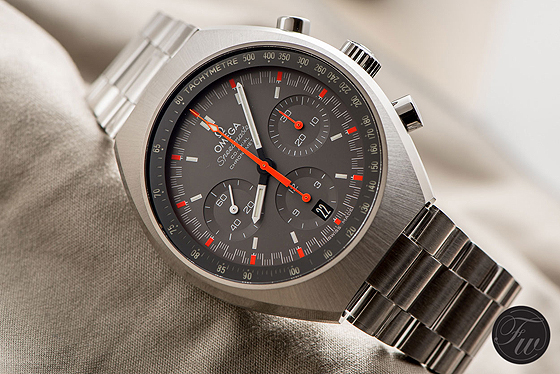
As you can see on the photo of the new Speedmaster Mark II Racing (below), the barrel-shaped case and bracelet are very similar to those on the original version. We will come to that comparison later on. If you take a closer look, you will notice that the dial is somewhat different from the original. The racing track is a bit different from the original, which had a red outer track and an orange Omega logo at 12 o’clock. However, the biggest differences are perhaps in the text on the dial and the fact that the new Speedmaster Mark II 2014 model has a date aperture. Instead of a no-date, hand-wound chronograph movement – like the one that is still being used in theSpeedmaster Professional 357x.xx series – Omega decided to use its Caliber 3330 movement. This movement has a column-wheel mechanism, a co-axial escapement, an Si14 silicon balance spring and a power reserve of 52 hours. It has little similarity with the original movement, except for the tri-compax layout of the dial, of course.
Omega Speedmaster Mark II Racing
People have asked us about the base movement for Omega Caliber 3330, as it is not one of Omega’s in-house-developed chronograph movements (Caliber the 93xx series). We tend to think that it is based on some ETA caliber that has been tailored for exclusive use by Omega only, hence the Si14 balance spring and co-axial escapement. It is understandable that Omega decided to use this movement. It is probably not a watch for the purist – although it is an awesome timepiece – but more for someone who loves vintage watches but wants to wear something new. There also may be some collectors who just feel that they need a piece like this in their Speedmaster collection. We believe that the target audience, though, is the guy who loved seeing the vintage Speedmaster Mark II on the wrist of his father or grandfather and has decided to go with a similar timepiece with all the modern technology inside. For the purists, there are still some great pre-owned vintage Speedmaster Mark II models out there that are priced attractively.
Omega Speedmaster Mark II - side view
Omega Speedmaster Mark II Rio 2016 - back
Omega Speedmaster Mark II - back
So, would you opt for the old, original Omega Speedmaster (Professional) Mark II or would you rather have one of the new versions? We’ve put the old Speedmaster Mark II Ref. 145.014 next to the new Ref. 327.10.43.50.01.001 and show you the optical differences between the two. (We’ve already discussed the movements a bit so need to compare those.) The dimensions of the new Speedmaster Mark II are 42.4 mm x 46.2 mm, whereas the vintage model measured 41.75 mm x 45 mm. This means that the new model is slightly bigger, which is evident in the photos below.
Omega Speedmaster Mark II vintage vs. new - side-by-side
Omega Speedmaster Mark II vintage vs. new - on wrist
On the dial, you will notice that – besides the date window, obviously – there are other differences between these two. It seems that the new Omega Speedmaster Mark II with the matte black dial has the same graphics printed on it as the racing version, with the exception of the use of orange for some of its accents. The minute track and hour markers are quite different from the Speedmaster Mark II 145.014 model. It is clear that the old model has a dial that is more similar to the Speedmaster Pro “Moonwatch” than to its 45-years-younger successor. The hands have also changed a bit, and are now a mixture between the original Speedmaster hands and theSpeedmaster Mark III hands. Although the vintage Mark II in the photos is a bit roughed up, you can clearly see the similarities between the style of finish on the case and bracelet. The polished edges on the case give a superb contrast to the sunburst brushed finish of the upper side of the case. Keep in mind that the Speedmaster Mark II’s sunburst brushed finish is a magnet to scratches – this doesn’t have anything to do with the material, only with the type of finishing – and it will require a pretty good watchmaker to deal with this. In any case, we’d advise you to have this finish redone by Omega, which has the proper machines and knowledge.
Omega Speedmaster Mark II vintage vs. new - stacked
Omega Speedmaster Mark II vintage vs. new - sides
The bracelet clasp is also something that you will immediately notice when comparing these two. The old steel clasp is just a straightforward folding buckle whereas the new clasp is in line with all the other modern Omega clasps — two release buttons and easy to resize. Again, the one you’d choose depends on your personal preferences and whether buying a vintage watch is in your comfort zone. Buying a nice vintage watch of any kind will require a bit of research. For the modern guy who merely wants a modern watch with a cool, vintage look, the new Omega Speedmaster Mark II Co-Axial might be the right choice. The black dial version is Reference 327.10.43.50.01.001 and has a price tag of approx 4,600 euros (including VAT). The orange Speedmaster Mark II racing is Reference 327.10.43.50.06.001 and has an (approx.) 4,600-euro price tag. A vintage Omega Speedmaster Mark II 145.014 in good condition can be found for below 1,800 euros. For now, that is.
Omega Speedmaster Mark II vintage vs. new - clasps
The official presentation on this Speedmaster Mark II watch can be found on the Omega website, where you can switch off the light to see the illumination of the dial and where you can resize the bracelet. What model do you prefer? The vintage Mark II or the new model? Let us know by leaving a comment below; we are curious to know.

Wednesday, April 6, 2016

How to Buy Pre-Owned Watches

The market for pre-owned items is huge. The success of websites like Craigslist, AutoTrader and so on are a testimonial. And the wristwatch market is no exception. Although a wristwatch is often a very personal item, at some point people are willing to part with it and trade up for something more expensive, or more special to them. This week, we offer some guidance on where to look and what to look for.
Before we start, it is important to understand that the market for pre-owned watches can be divided into two categories, those being fairly recent watch models and vintage watches. For this discussion, we’ll stick with pre-owned watches from 1990 and later. Everything before 1990 could be considered “vintage,” although some define “vintage” as meaning prior to 1980 or even earlier. Why do we draw this line? Because buying vintage watches requires a bit more expertise and explanation. We will cover the topic of buying vintage watches separately in a future article for WatchTime.com. Why would you buy a pre-owned watch? Well, first there is the chance that a watch that you really like (or always have liked) is out of production and simply not available anymore. In this case, the only chance to obtain such a watch would be in the pre-owned market, unless you’re hoping to come across a never-used model at a dealer who never sold it in the first place, and chances of that happening are pretty slim.
Another reason might be the depreciation on a pre-owned watch. This depreciation is, for some watch brands and models, a bit more applicable than for others. The comparison with cars is not the best one, as those depreciate like almost no other ‘durable’ product, but even here, there is a difference in the depreciation of a BMW 328i and an Alfa Romeo (whatever model), for example. It’s the same with watches. The depreciation of a stainless-steel sports Rolex is far less than that on a quartz Chopard ladies’ watch. Almost any watch will acquire some depreciation; it is up to you to decide how much depreciation is acceptable when you’re considering the purchase of a pre-owned watch rather than a new one.
Vintage Rolex & Omega
The aspects to take into account when shopping pre-owned are worth mentioning here as well. As with a pre-owned car, you’ll want to know a few important things. For watches, you should focus on:
Service history
This isn’t so important if the watch is just one or two years old, but always ask about the service history of the watch and for the invoice. Since servicing a mechanical watch will cost you quite a bit these days, chances are small that the seller discarded this important document. If no invoice exists, assume that the watch hasn’t had a service overhaul. Calculate the cost of paying for this service yourself and add it to the watch’s price and decide whether it is still worth going forward. Ask for the official service cost at an authorized dealer, or ask your local watchmaker. Also, ask whether he (or she) is capable of servicing the watch you are about to purchase.

Vintage Tudor Pelagos
Box and papers
If a watch is 30 to 40 years old, it is very likely that its original box and manuals are gone. For some reason, the owners didn’t care about these things (and sometimes still don’t). My father, for example, received a beautiful Omega in the late 1960s without a box or papers. These were just left at the dealer as he saw no reason to bring them home. With today’s packaging, in which a lot of effort has been put into a nice wooden or leather box, detailed manuals, warranty cards and so on, you should really look for an all-complete set. Of course, if the watch is very special and you’re relatively sure you’ll never to never part with it, and the price is right, you might decide to pull the trigger on it without these accessories anyway. Also, make sure you’re getting the correct box for your specific watch. It should at least be period-correct. Throughout the years, some watch brands used several different boxes for their watches.

Omega Speedmaster Pro with Box and papers

Scratches and dents
A watch should be worn. We have little use for people who put their new watch in a safe and never look at it again. Even if it costs $100,000, a wristwatch is meant for the wrist. Not every watch is suited for daily wear, but is a pity to see some of these beautiful watches disappear in collections that never see daylight. Of course, a watch that has been worn will get some tiny hairline scratches, a few deep scratches, and even an occasional dent. Always ask yourself what kind of shock or bump a watch must have received if a scratch is very deep or if the case has multiple dents. Remember, it is not only the case that has been knocked around, but also the mechanical movement inside. If a watch case has a dent in one of its lugs, it was probably dropped on the floor and landed on just the wrong spot. You may still decide to buy it, especially if  you’ve checked to see that all its functions still work, but keep in mind that damages may go deeper than what’s visible on the surface. Also, when there is corrosion on the hands or applied hour markers, for example, ask yourself whether the movement is free of corrosion. If possible, and if the watch doesn’t have a display back, ask the seller if you can see the watch’s movement. Look for signs of corrosion and while you’re at it, also look for scratches and other signs of abuse.
Audemars Piguet Royal Oak - vintage
Audemars Piguet Royal Oak - vintage - back
We could go on and on about the things you need to look for, but in general, make sure you don’t ever consider buying a pre-owned watch without some knowledge of it. On Fratello Watches, we started with an Omega Speedmaster Buyer’s Guide to assist people who are looking for a new, pre-owned or vintage Speedmaster watches. There are other initiatives like this on other platforms as well for other brands and models. Last but not least, where does one go to find a nice pre-owned watch, anyway? As mentioned above, just as there is a Craigslist and an AutoTrader website, there are also on-line market platforms for pre-owned watches. Chrono24.com is definitely the world’s largest platform for watches and has more than 150,000 offers on watches from both professional sellers/dealers as well as private sellers. Another interesting initiative is watchrecon.com, a website that curates the offers on pre-owned watches from various watch forums and communities. This will save you the time you might take to search these forums one by one.
Some of these online sellers also have a brick-and-mortar shop as an extension to their online offerings, which means that you can visit the shop and see in person the watch you’ve seen online. It is always recommended that you see a pre-owned watch with your own eyes, and fiddle around with it a bit, instead of just buying it online without the opportunity to do a little inspection.
Omega Speedmaster Professional Snoopy
Some authorized watch dealers also carry a selection of pre-owned watches. These are mainly watches from clients who traded up to a more expensive model. Ask your local watch dealer about pre-owned watches. Most of them have a good relationship with their clients and might know someone who is willing to part with their watch. Then there are these watch auctions (both off- and online) carried out by several companies, including Auctionata, Bonham’s, Christie’s, Sotheby’s and so on. Be aware of the fact that, in most cases, you will be able to see the watches before the auction takes place, but also that there will be other bidders, so there is uncertainty regarding the final price, not to mention that you’ll have to pay a 20% fee to the auction house. Last but not least, always ask about warranty. In the case of a young, pre-owned watch, there might still be a factory warranty. If you buy the watch from a professional watch seller, a 6-to-12-month warranty is common.

Tuesday, April 5, 2016

10 Things You Should Know About Wrist Watch Auctions

BY ARIEL ADAMS

Watch auctions and dedicated timepiece auction houses are more popular now than ever before, and we'd like to try to explain what you need to know before becoming a potential auction bidder. Without a doubt, it is an exciting time to be a watch lover, because the world is talking about timepieces more than ever. On the one hand, you have the gradual emergence of the smartwatch industry that, despite concerns from some low-end brands, will likely have the outcome of making people notice wrist watches more than the general public has in the last 20 years. On the other hand, you have a new form of financial investment mentality surrounding the exciting world of high-end luxury watch auctions and the rising ceiling of potential values, as well as the apparent expanding pool of potential watch buyers. The result isn't just an increasing frequency of watch-themed auctions, but also entire new businesses dedicated to bringing more watches to auction for more people.
I would go so far as to say that the watch auction market is in a bubble. Existing auction houses are increasingly focused on timepieces, and many new auction houses are popping up hoping to attract horological collectors around the world. I talked about some of the major watch auction houses here on Forbes. There are so many timepiece-related auction houses and so many timepiece-themed auction events, it is, in my opinion, mostly unsustainable for the long run. Many of these events focus on just a few featured auction lots or highlight pieces that the organizers hope will attract major collectors; the rest of the auction lots are far less interesting pieces. Don't forget that rare and valuable timepieces are actually rare. It isn't common for there to be timepieces such as the Patek Philippe Supercomplication that go for $24,000,000.
10 Things You Should Know About Wrist Watch Auctions Sales & Auctions
The competition for "blockbuster lots" is getting fierce, and in some circumstances, auction houses are accused of unethical conduct in disclosing the provenance of a watch as related to its total authenticity or actual ownership. To that latter point, it should be stated that in many instances, celebrity ownership of a watch can vastly increase its value. There are other factors that I will discuss below, which I feel people interested in participating in watch auctions should know before fully committing to a major purchase or bidding at one of the major watch auction events around the world.
We don't cover watch auctions on aBlogtoWatch that often for pretty specific reasons. First of all, there are so many of them that we could talk about upcoming auctions a few times a week, and the rest of the time discuss their results. Most of them are just people trying to sell stuff, and so covering them isn't all that interesting to me personally, because it doesn't offer information about new products, interesting techniques, or how to better appreciate timepieces on an intimate level. Further, the yielded prices that auction houses promote aren't those that represent the value of most watches. In fact, in a lot of instances, watches sold at auction are pretty cheap. The lots they highlight are those of a few select timepieces that are pretty rare to begin with, but that tend to circulate at auction a lot. Mostly, I don't necessarily trust watch auction results in terms of indicating trends or the inherent value of items. An example is that the same model watch can go for $1,000 in one auction and $5,000 in another auction for no other reason than emotions and the people who happen to be paying attention at the event.
Emotions, of course, are important and are the basis of all "collecting" and appreciation of art. Having said that, I personally feel that prices at auctions need to be more about inherent value, rather than competition amongst a select group of privileged buyers. I want to offer a summary of my personal feelings about watch auctions by suggesting that in a huge way, they are very valuable for people looking for good prices on used or older watch models. If, however, you are thinking about watch auctions as an investment vehicle or believe they are a good basis for valuing a brand or its products, then it would be wise to proceed with caution. The auction world is one place where the concept of caveat emptor should be something for people to consider. So here are 10 important things you should know about watch auctions:
10 Things You Should Know About Wrist Watch Auctions Sales & Auctions

1. Timepieces Make Poor Financial Investments

You aren't likely to get rich by purchasing timepieces and later selling them at auction for profit. Most honorable auctioneers will certainly agree. Timepieces are "emotional investments" whose values can fluctuate wildly and on a whim. If you are the type of person who is very good at understanding the mentality behind purchase decisions, and feel like you want to take a stab at manipulating a market then you might have what it takes to be amongst the few people in the world who make money by buying and selling timepieces at auction.
Everyone else should be aware that timepieces make excellent collectibles and are wonderful to learn about and own, but consider them a luxury expense and not an investment vehicle. This is important to think about, because some watch companies, retailers, or auction houses like to suggest the notion of items increasing in value over time, and that purchasing certain timepieces is a "good investment." Watches make as good of an investment as cars do. Most lose a lot of value after being purchased new and have an expected level of depreciation each year. If you are lucky enough to have a car (or watch) that will vastly increase in value and wasn't extremely expensive to begin with, it will most likely only do so long after you have passed away.
10 Things You Should Know About Wrist Watch Auctions Sales & Auctions

2. Provenance Is Not Guaranteed

The fact that a timepiece was owned by a celebrity or important person is, not surprisingly, linked to higher auction values. In my book, The World's Most Expensive Watches I discussed a Longines wrist watch owned by Albert Einstein that went for several hundred thousand dollars at auction, while the same timepiece without its celebrity provenance would have been worth dramatically less. Therefore, the story of who owned a timepiece is, in many instances, worth a lot more than the watch itself. Knowing this, watch auction houses often attempt to bolster the importance of a watch or other object by trying to connect it with an important person, place, or event. The problem is that in some instances, they are simply wrong. Claims about a watch's ownership or provenance are supported by various types of documentation such as receipts, letters, pictures, and more. A close examination of the evidence about a timepiece's proclaimed ownership is really important in getting the full story, because in the worst instances, the auction house is flat out lying.
10 Things You Should Know About Wrist Watch Auctions Sales & Auctions

3. Watch Auctions Are Highly Glamorized

The most successful auction houses in the world such as Christie's and Sotheby's put out beautiful catalogs with lavish pictures and descriptions of the items they intend to sell. These companies, and others like them are masters of presentation. Watch auctions themselves are often semi-formalized events with their share of VIPs and media. Watch auction houses also dedicate a lot of media to promoting and advertising their sales. This is all sound business and something that legitimately helps inform interested people in their upcoming auction events. This glamour, however, is part of the sales technique, and is designed to make people feel excited about participating, as well as about the results of an auction. Watch auction houses also often work with various charities and other organizations to do benefit events and help raise money for philanthropic causes. In this sense, watch auction houses are about entertaining a particular wealthy demographic with sales events, as much as they are about offering collectors a venue to own rare and desirable goods.
10 Things You Should Know About Wrist Watch Auctions Sales & Auctions

4. The Success Of Not Vintage, But Pre-Owned Watches Drives Auctions

The majority of watch auction events include dozens if not hundreds of lots for sale. However, when many people read about a watch auction, there are only a few "auction highlights" that are promoted. These are the "superstar" lots that mostly include interesting or desirable vintage watches which have a known likelihood of achieving high values at auction. Sometimes, would-be bidders mistakenly believe that these highlighted watches represent the majority of the lots in an auction. That isn't true. In fact, if there is just one take away message from this entire article, it is that modern watch auction events are mostly sustained by the sale of much newer pre-owned or unsold retail stock timepieces. These are where the best values are for consumers, and what keep many of the auction houses going - not a steady stream of exotic rare timepieces or vintage favorites.
10 Things You Should Know About Wrist Watch Auctions Sales & Auctions

5. Be Careful Of Auction Fees & Premiums

There are a few reasons that eBay.com became so popular. Among them are the fact that eBay makes it very cheap (and easy) to host an auction, and because people can bid on their own time using an automated system. Outside of eBay and its competitors is the traditional world of auction houses' fees and premiums - which vary from company to company. The basic idea is that when an auction house puts up something and it sells, they collect a fee from both the buyer and the seller. These fees are not unsubstantial.
Sellers go into the process knowing that perhaps 10-20% of the final bid value will be taken by the auction house as a fee. There are a lot of good reasons for this, and the decision to sell something using an auction house is usually based on the notion that despite the fees, the auction house helped them get more money than by doing it themselves. However, most auction houses also collect buyer's fees (known as a "buyer's premium") - and these can be more tricky to comprehend.
Auction houses frequently charge higher buyer's premiums than they do seller's fees. These fees and premiums are most always a percentage of the total value that tends to exist on a complex sliding scale. So while auction houses earn 10-20% of the total amount given to a a buyer during a successful sale, they often charge 10% to sometimes over 30% as a buyer's premium over the final hammer price. That premium is calculated after the final bid, and is not part of what the seller receives. You can therefore understand why auction houses are so excited to not only have sellers commission items with them, but to also have buyers engage in bidding wars. As someone who may potentially bid in a watch auction, you should be extremely familiar with how buyer's premiums are calculated and know that they will be in addition to the final hammer price.
10 Things You Should Know About Wrist Watch Auctions Sales & Auctions

6. Watch Brands Often Buy Their Own Watches At Auction

Depending on the situation, a watch brand may either explicitly or secretively bid and win one of their own watches. In the most ethical instances, a watch brand openly bids on a watch from their own history. The watch company Breguet, for example, often attempts to purchase historic timepieces and clocks produced by the brand's namesake and his family. Many of these timepieces are over 200 years old. Breguet, and others like it are trying to "reclaim" their history for historical preservation and study, as well as to show them off in various exhibits. Of course, these brands don't always have as deep pockets as some of the competitive bidders.
Less ethical situations involve instances where watch brands secretively bid (via a proxy bidder) on their own timepieces in order to manipulate the auction or the market for their products overall. This situation can be just about engaging in a bidding war so that a particular items goes for a higher amount, or it could be part of a more concerted effort, in an attempt to show that their timepieces are more desirable and/or more valuable. This practice does happen from time to time, and can be very difficult to detect. It is also rather effective, because of the anonymous nature of some bidding, and because even buying your own watches for a large sum of money is enough to offer material to show the market how valuable your brand might be.
10 Things You Should Know About Wrist Watch Auctions Sales & Auctions

7. Million Dollar Watches At Auction Are Rarer Than You Think

Patek Philippe and Rolex are perhaps the most successful names when it comes to watch brands that perform well at auction. Among the two, Patek Philippe has a lot more "million dollar watches" it can claim, based on its history of producing complicated exclusive timepieces. Even traditionally, Rolex was in the market of producing a lot of watches. Rolex's most valuable timepieces at auction are prototypes, limited production models, and other low production pieces. There are a healthy number of watches throughout recent history that have achieved winning bids for more than $1,000,000, but they are rare. Often times, they are actually the same watches that circulate from auction to auction exchanging hands among elite collectors. The majority of Rolex and Patek Philippe timepieces at auction are far more reasonably priced, and only a handful are those that are able to surprise people with intensely high prices.
Those latter models are what tend to be the lots that beat auction estimate values. Most auction lots fall within the conservative estimate values or come in below. So, not only are watches that can achieve million dollar prices rare, but most watch auction lots yield extremely predictable prices or come in under estimate.

10 Things You Should Know About Wrist Watch Auctions Sales & Auctions

8. In Our Opinion, A Lot Of Watch Auction Values Are Inflated

In an ideal world, the pure economics of "supply and demand" would rule the auction market for all things, including rare, collectible, or merely unsold timepieces. That isn't always the case when it comes to watch auctions, because too many buyers are unfamiliar with actual demand. Auction houses are, of course, in it to maximize profit, so in their eyes, everything they put up for auction is "rare, amazing, fine, important, collectible, etc..." That isn't always true, and when it comes to niche items like timepieces, the auction houses have actually managed to create markets and values where, in many instances, there was none before. Of course, sometimes watch auction houses are merely influenced by trends set by smaller groups of collectors who happen to be keen on particular products.
This latter notion is important because collectors are often highly emotionally driven when it comes to what they purchase. Just a few collectors hot on particular products can completely alter the market because some of those items are very rare and collectors' purchasing habits are closely monitored. What that means is that the value of certain timepieces can go up several hundred percent for short durations of time, and such an increase in value has nothing to do with their actual inherent or comparable value, but rather because some collectors have a temporary interest in something. So, the moral of the story is that a combination of niche collector activity as well as zealousness from watch auction houses can result in inflated pricing that does not always relate to larger market demand, but rather what entities with a vested interest feel that market demand should be. In short, the best watch auction houses are experts in collector psychology as much as they are auctioning off goods.

10 Things You Should Know About Wrist Watch Auctions Sales & Auctions

9. Watch Auctioneers Are Excellent Story Tellers

The best auctioneers aren't just people who can speak very quickly, but who are excellent sales people. Collectible items are all about connecting a physical item with a story and hopefully creating an emotional bond with a potential buyer that makes them feel like, "I have to have that!" When it comes to timepieces, the "story" is no different. Facts are blended with a sense of literary story telling that sometimes can exaggerate how important something is. A good example is the place a wrist watch had in the life of an important person or celebrity. A watch that was merely owned by a celebrity (perhaps rarely worn or a mere gift) can sometimes be described as having a pivotal role in their life during key moments in their career. Literary license surely can obfuscate important facts about the nature of such items. Technically speaking, it is fraud for an auction house to provide incorrect facts or lie to potential buyers, but there are many instances where the factual evidence is sporadic at best, and certain details are up for "interpretation."
It is, therefore, important for buyers to understand that auction houses want to make their auction lots sound as exciting as possible and will take every possible opportunity to stretch the facts and come to conclusions that simply aren't supported by the evidence. Sometimes, they may even make bold proclamations about watches, such as who owned them or how important they were, with extremely fragmented or tangential evidence. In many instances, the consumer must, once again, apply the notion of "buyer beware" when buying a story versus an item that comes with extremely persuasive physical evidence.

10 Things You Should Know About Wrist Watch Auctions Sales & Auctions

10. Anonymous Bidding Via Proxy Is A Double-Edged Sword

I mentioned above that in some instances, buyers make bids anonymously. This is often done via a proxy bidder who is taking orders on behalf of a anonymous client while at the auction itself. Auction houses do not require that the identity of a bidder be made public. In fact, many of the most prestigious auction houses pride themselves on keeping their clients confidential. There is good reason for this. If you are a noteworthy person or someone who has decided to purchase something very expensive, you don't always want the world to know. Auction bidding might be one of the "safest" ways to buy luxury and exclusive items such as priceless art, without the world knowing what you now own. So in some important ways, anonymous bidding serves a very useful purpose for some buyers.
As I mentioned, though, anonymous bidding can be a double-edged sword. While it has benefits, it can also have a deleterious effect on understanding how a final bidding price effects the market for a particular brand or item. Take, for example, a situation where two anonymous proxy bidders are actually the same person, and that person represents a watch brand keen on trying to protect or promote the value of its products. Less maligned are simply those situations where the nature of a buyer is important in helping other buyers know who they are competing against. Buyers could be individuals, museums, companies, governments, etc... While anonymous bidding has a very clear value, the potential for abuse or simple market confusion in the value of a item exists and is sometimes taken advantage of.
Monday, April 4, 2016

Expert Advice: 5 Tips for Buying Vintage Watches

Whether you’re buying out of sentimentality — say, you want to own a watch from the year of your birth — or simply for investment purposes, education is the most important factor when it comes to buying, or collecting, vintage timepieces. During my last decade of blogging for Fratellowatches, I have received numerous e-mails from people who’ve struggled with their purchase of a vintage watch; in nearly every reply to these e-mails, I have offered five bullet-point guidelines, which I will now share with you.
1.Don’t buy without investigation
It is tempting to make an impulse purchase on a nice-looking vintage timepiece that you see in the window of an antiques dealer or watch shop. However, there are many traps you can fall into — traps of which even the seller may be unaware. So make sure to do your homework and learn about the watch you want to buy. You should only pull the trigger on a vintage timepiece when you have become something of an expert on a brand or specific watch model. For some, risking $300 or so on a vintage watch isn’t a worry, but when you’re in the market for certain vintage Rolexes, for example, which can easily have a price tag of $10,000 or more, you will want to be sure you’ve done your research. When you notice very similar-looking watches offered at lower prices, you’ll want to know what the differences are. Perhaps needless to say, as with every major purchase, you are advised to go online and look up the watch you want before purchasing.
After you’ve determined which brand or watch model you are after, have a look at some of the watch websites that are regarded an authority on the subject. (It is, of course, easier if the watch is from a major brand rather than one that has long ago ceased to exist.) You can also find resources offline. Many books have been written on collecting certain brands, diving watches, chronographs, iconic watches, and so on. Often, these books can be found on Amazon or websites like WatchPrint. If you can’t find what you’re looking for there, you can check out eBay, where many sellers offer books that have been long out of print. Also, compare. Try to find similar watches at watch shops (both online and offline) and note their condition and prices. After a while, you will get a fairly good understanding of the market prices and the conditions these watches are generally in. Pay attention to the details: do all these watches have similar hands, printing on the dial, bracelets, bezels, date disks, et cetera? In the case of a Rolex or Patek Philippe, this can be the difference between spending $5,000 or $10,000 or more. Train yourself to have an eagle eye!
2. Share the passion
Many fellow collectors of vintage watches are online as well, and often share knowledge about the watches or brands they are passionate about.  You can go to the major watch forums on the internet and read many of the experiences that others have posted. Make use of the search functions of a forum before asking any questions; some of the questions have been asked a thousand times before, and have already been answered. If you are looking for an exotic brand that has no specific forum of its own, you can go to the bigger watch platforms, where you will either find generic (or ‘public’) forums or a vintage section that covers a range of brands. Make sure that the questions you ask are very specific. If you already have seen a watch you like, include a few pictures and clearly state the model name and — if possible — the reference number and specific caliber that is inside. This will help the experts to give you the correct answers. In the end, make sure that you don’t remain simply a “lurker” — share your own experience of buying a vintage watch.
Vintage Jaeger-LeCoultre watches
Vintage watches from Jaeger-LeCoultre
3. Contact the manufacturer
A number of watch brands have a rich archive of what they have produced in the past. At some of the brands, you can even request an extract of the archives (this might cost a bit of money) with information about its production year, country of destination, number of pieces produced, caliber number, and case and/or reference number. Also, some brands have a point of contact for you with questions about their vintage watches or movements. Be patient. Don’t bother them every other day, asking if they’ve had the chance to read your e-mail. These brands get many similar e-mails from collectors. If you’ve had no response after two weeks, you might want to send a friendly mail to ask again.
4. Find a watchmaker
Based on my personal experience of collecting watches since the late 1990, this is probably the best tip I can give you, next to educating yourself. Find either an independent watchmaker or one who works for a large retailer. He will be your new best friend for years to come. Ask around for a watchmaker with plenty of references, and more importantly, ask if he is able to source replacement (or new) parts. Some watchmakers specialize in a certain brand or have strong knowledge about specific movements. Also, don’t be afraid to ask about prices, and about how long it generally takes to service or repair watches. Some of the repairs can take a long time, mainly because some parts of vintage watches are very difficult to source. Sometimes, parts are no longer available at all and need to be re-created from scratch. Ask about all these things when you contact a watchmaker. If he can’t do the job, don’t hesitate to ask if he has any colleagues who can. Again, some watchmakers have very specific skill sets and specialties. You won’t offend them by asking.
5. Find the Right Price
Ah, price… for some people, the most interesting part. As stated above, prices might vary widely on watches that look very similar. The most important things is that you compare the watch you want to others like it by checking online watch-market platforms or offers at watch shops. Is overpaying for a watch the end of the world? No, as long as it is doesn’t exceed too far the average market price, and as long as you’re happy with your purchase. Sometimes, people fall in love with a watch due to a specific patina on the dial or the faded color on a bezel. If that’s worth a bit extra to you, go for it. However, you don’t want to pay too much for a watch that is clearly not worth it. So again, compare! Ask about the guarantees a seller can give you in case you find out – after purchasing the watch – that it is not as “original” as it appeared to be or that it doesn’t function properly. In the latter case, of course, keep in mind that it is sometimes difficult to give a two-year warranty on a 50-year-old watch. Be realistic, but make sure you have at least a gentlemen’s agreement on returning the watch if you are not satisfied. Having said that, it is important that you buy from someone with a good reputation for selling vintage watches. Word of mouth is very important, and any negative comments on his way of selling watches can destroy his business. However, if there are any points of discussion after the purchase, it’s best to remain calm and keep the communication open and friendly.
A bit of negotiation is expected when it comes to buying a vintage watch, but also keep in mind that excessive bargaining might have effect on the seller’s willingness to help you out afterward if something is wrong with the watch. More importantly, ask your watchmaker (see #4) or the watch manufacturer (see #3) what the price would be of a service overhaul. From my personal experience, I always calculate a service into the price when buying a watch. So, if the watch doesn’t function properly but you don’t want to return it (maybe it’s still the nicest watch you’ve ever seen), you’ve at least kept a bit of budget available to have it overhauled. Those are my top five. Collectors, any additional tips that I’ve missed? Please leave them for others — and me —to read in the comments. For those who are new to the vintage collecting game, let me know if these were helpful!
Omega Speedmaster 1960s vintage
Vintage Omega Speedmaster